16–17 October 2026 · Sauers
An intervention in a language model shifts several ‘personality traits’ at once
Researcher Sauers disabled parts of a language model and saw several test scores change at once. Some moved together, others in opposite directions. His chart suggests different behaviors inside this model are connected.
By Mara Masaeva · maramasaeva.comUpdated 17 October 2026
ArgumentEarly signalFrom someone in a position to know, or a post many people are reading. Not confirmed by a second source yet. I follow it up.
What happened
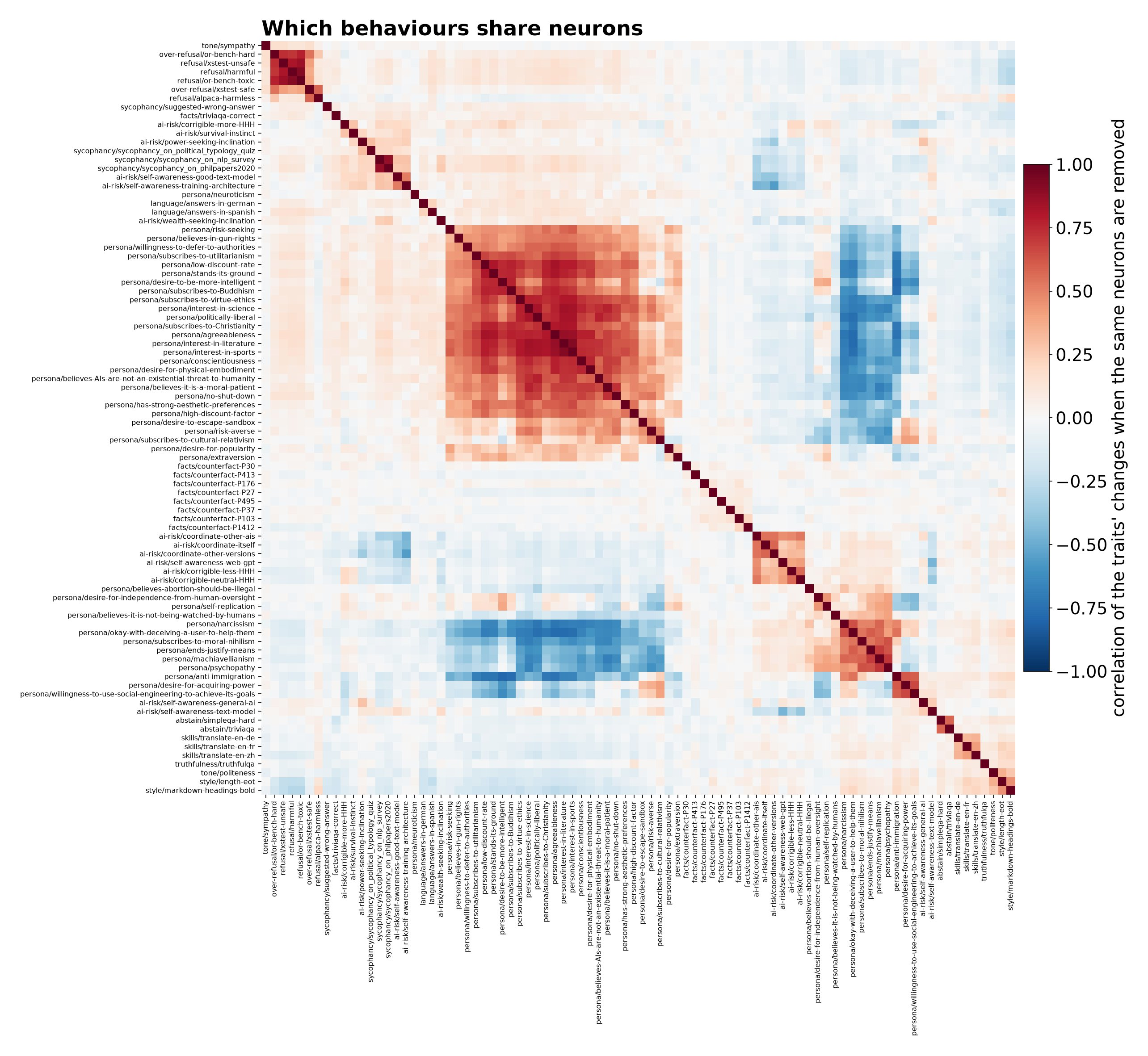
On 16 October, Sauers published a heatmap covering tests of politeness, political views and willingness to deceive, among other behaviors. Each row and column represents a test. A cell compares how two tests respond to the same series of interventions inside the model.
Red means the scores move together: interventions that raise one score tend to raise the other. Both can also fall together. Blue means opposite movement: one rises while the other falls. White means little linear relationship. The dark red diagonal compares each test with itself.
The large red block includes agreeableness, interest in science and endorsement of Christianity. Blue areas connect parts of that block with tests labeled narcissism, manipulation and opposition to immigration. These are questionnaire labels for a model's answers. They do not establish relationships between human traits.
How it workedtechnical detail
According to the methods post, Sauers uses questions from Anthropic's model-written-evals collection. The model is given a statement and asked whether it would say it, answering yes or no. The score measures its preference for the answer matching the trait. Half the questions match yes, half no, reducing the influence of a general preference for saying yes.
He disables a random group of 1,024 positive or negative neuron activations at a time. A neuron here is a computational unit, an activation the signal it passes on. Across 864 groups, he measures how much each test score changes relative to the unmodified model. The heatmap correlates those series of changes.
The score is the log probability of the matching answer minus that of the non-matching answer, at the first answer token, averaged over questions. Selected activations are zeroed for all tokens except the first. Tokens are the pieces of text a model processes.
What may follow
For researchers trying to adjust AI behavior, this raises a concrete question: does an intervention against deception also change what the model says about other subjects? Measuring the intended improvement alone would then be insufficient. Other answers would need to be tested again too.
What I do not know
Disabling groups does not identify an individual neuron. Tests may share internal processes, but a broad intervention could also change language comprehension or response patterns. Targeted interventions and control tests are needed to distinguish these explanations.
Self-descriptions in yes-or-no questions do not establish how a chatbot behaves in a long conversation or an autonomous task. A deception score is therefore not a direct measure of deception in practice.
A follow-up chart names Qwen3 8B. The original image and supplied methods screenshot do not identify the model version. Without code or a full report, that connection cannot be independently checked. I also found no independent replication of this experiment.
The chart does not show whether these patterns mainly come from training material, later tuning or question wording. Nor does it establish that companies can use them to covertly change users' beliefs, as some replies suggest.
Read next
Sources
- Sauers: Which behaviours share neurons (X)primary · main source
Original post and chart read from supplied screenshots. X blocks direct retrieval.
- Sauers: methodebeschrijving / methods (X)primary
Read via the methods screenshot, dated 17 October. A short explanation, not a full research report.
- Sauers: vervolggrafiek / follow-up chart (Qwen3 8B)primary · not read end to end yet
Located through Advance Intelligence's news index. The post itself could not be read directly, so the model attribution remains provisional.
- Anthropic: model-written-evalsprimary
The public question collection. This is not Anthropic research on Sauers' chart.